Tracing Dialogue Tree Variations in Choice-Driven Narratives to Map All Possible Character Development Arcs
Written by Morgan Simon · Aug 25, 2026
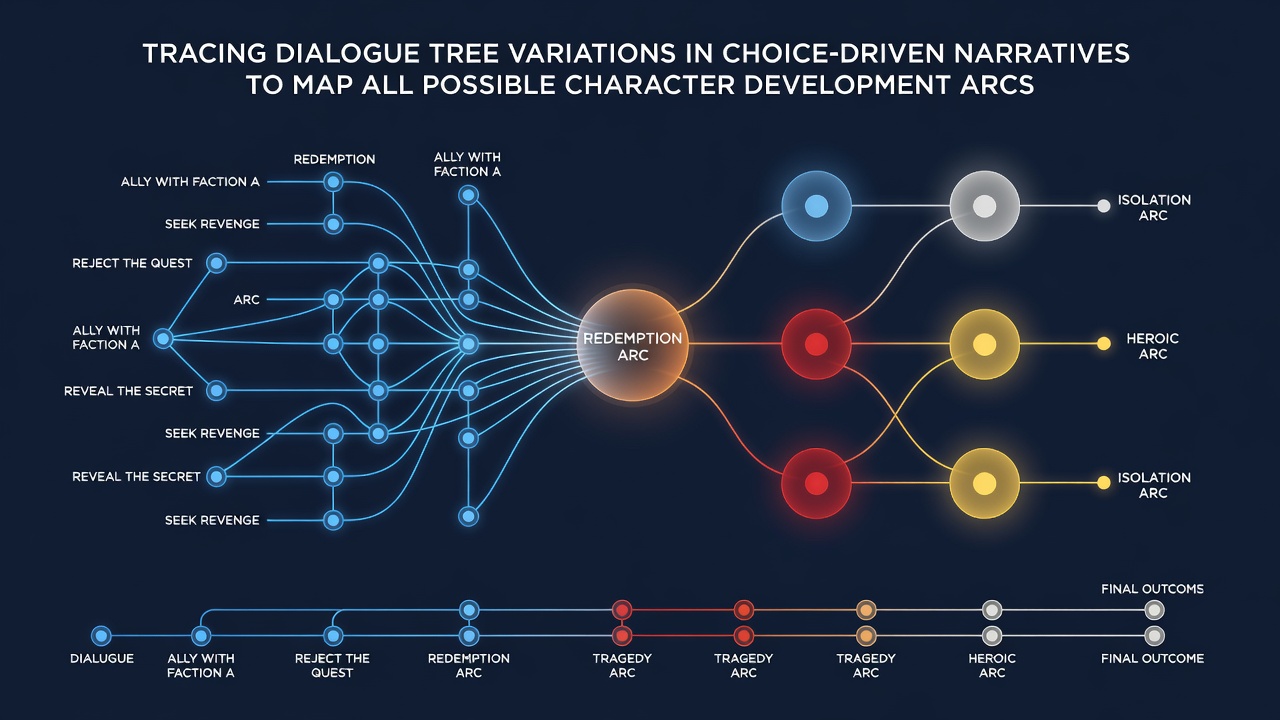
Tracing Dialogue Tree Variations in Choice-Driven Narratives to Map All Possible Character Development Arcs
Choice-driven narratives rely on dialogue trees that branch based on player selections, and tracing those variations allows analysts to map complete sets of character development arcs across multiple playthroughs. Researchers in interactive media studies examine these structures by logging every node, edge, and conditional trigger that alters dialogue outcomes. Data from such mappings shows how individual choices compound over time to shift traits like loyalty, morality, or ambition in consistent patterns. As of August 2026, several academic labs continue refining graph-based tools that automate the enumeration of these paths without requiring exhaustive manual testing.
Core Mechanics of Dialogue Tree Construction
Developers build dialogue trees as directed graphs where each node represents a line of speech or internal state, and edges carry conditions such as prior decisions, inventory items, or relationship scores. Analysts trace variations by simulating all valid sequences while recording state changes at every step. Studies from institutions like the University of Alberta's narrative computing group demonstrate that even modest trees with twenty decision points can generate thousands of unique arcs when hidden variables accumulate. Those who study these systems note that pruning redundant branches early helps isolate arcs that genuinely affect long-term character evolution rather than momentary flavor text.
Methods for Mapping Character Arcs
Mapping proceeds through layered analysis that separates surface dialogue from underlying trait vectors. One common approach records numeric scores for attributes such as trust or aggression after each interaction, then clusters resulting trajectories into recognizable arcs such as redemption, betrayal, or steady growth. Software used by narrative designers exports these clusters as heat maps that highlight convergence points where multiple paths lead to the same endpoint. Evidence from European research consortia indicates that convergence often occurs near mid-game thresholds, after which later choices refine rather than redefine the arc. Observers note that this clustering technique reduces visual clutter when presenting results to writers who must balance branching complexity against production budgets.
Tools and Data Practices in August 2026
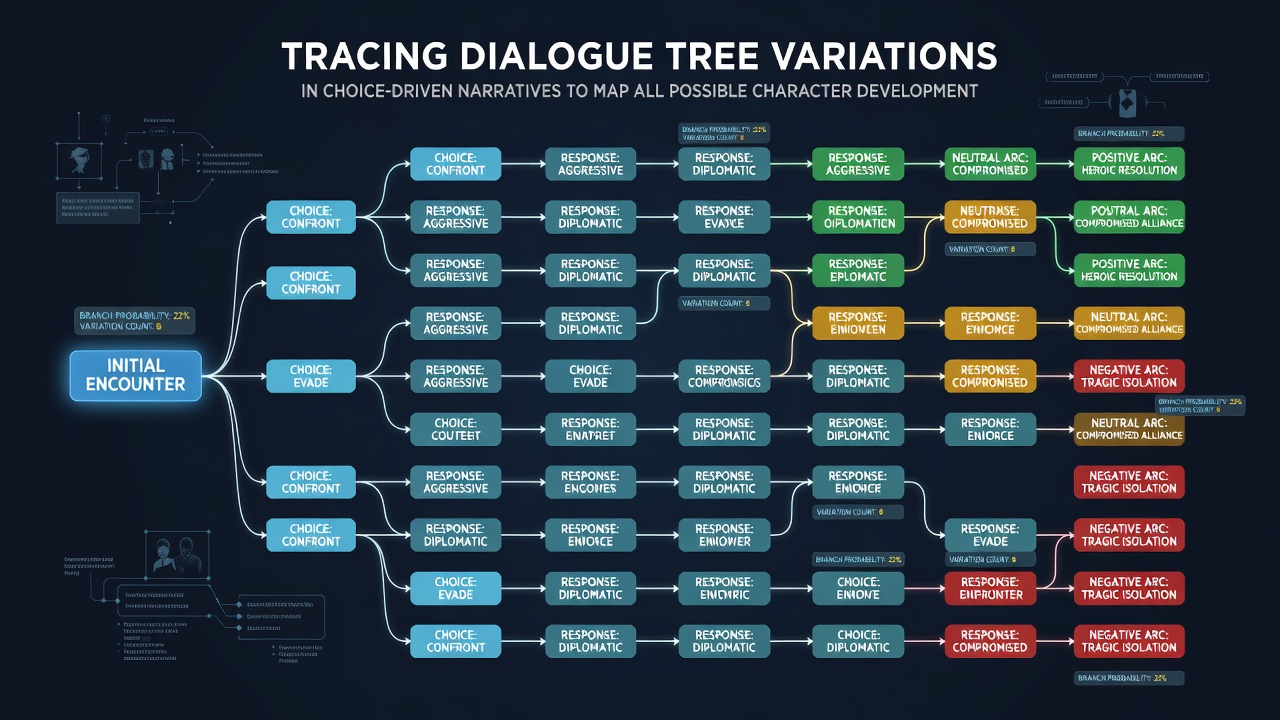
Current toolchains combine graph databases with custom scripting to replay every feasible path while logging state deltas. Teams at independent studios feed these logs into visualization platforms that render arc timelines side by side. Figures released by the Interactive Digital Narratives Association reveal that automated traversal now covers trees exceeding five thousand nodes within acceptable runtimes on consumer hardware. Analysts cross-reference these outputs against player telemetry collected under ethical review board guidelines to confirm which arcs actually occur in real sessions rather than remaining theoretical. Such validation steps prevent overcounting of paths gated behind rare item combinations or time-limited events.
Case Examples from Published Titles
Take one widely studied title where companion loyalty tracked across three major decision clusters produced seven distinct end-state arcs. Researchers documented how an early refusal to share resources locked certain companions into distrust trajectories while later acts of sacrifice could still pivot them toward reconciliation. Another project mapped rival character arcs that diverged sharply depending on whether players exposed or concealed key information during pivotal conversations. Data collected across thousands of sessions showed that roughly 18 percent of players reached the most extreme versions of these arcs, underscoring how rare some branches remain despite their narrative weight.
Challenges in Complete Enumeration
Complete mapping faces hurdles when conditional logic references external systems such as procedural weather or faction reputation that change independently of dialogue. Analysts address this by isolating dialogue subgraphs and treating external factors as controlled inputs during simulation runs. Reports from Australian interactive media centers emphasize the value of modular testing frameworks that allow incremental expansion of covered variables without restarting entire traversal suites. Those frameworks also flag dead-end paths that terminate character development prematurely, giving writers clear targets for additional content.
Conclusion
Tracing dialogue tree variations supplies a systematic view of how choice sequences translate into character development arcs. The process combines graph analysis, state tracking, and validation against observed play data to produce reliable maps. Continued refinement of automated tools supports larger narrative scopes while maintaining accuracy across diverse project scales.