Mapping Texture Streaming Behaviors to Reduce Pop-In During High-Speed Traversals in Open-World Racers
Written by Theo Werner · Jun 7, 2026
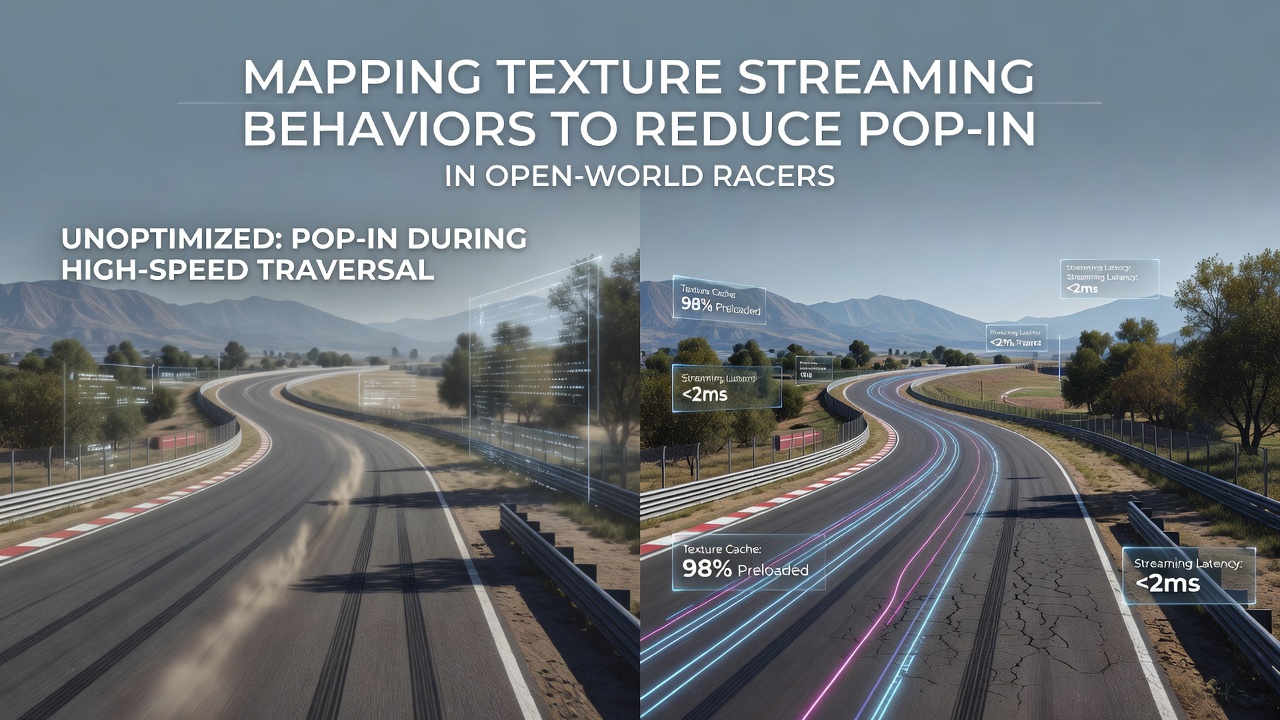
Mapping Texture Streaming Behaviors to Reduce Pop-In During High-Speed Traversals in Open-World Racers
Texture streaming manages the loading and unloading of surface details in real time as players move through expansive game worlds, and in open-world racers this process faces unique pressures from sustained high velocities that can span hundreds of kilometers per hour. Developers track these patterns by logging asset requests against camera trajectories, vehicle speeds, and terrain complexity to identify moments when low-resolution placeholders remain visible for too long. Observers note that such mapping reveals predictable bottlenecks where memory bandwidth and storage latency fail to keep pace with rapid viewpoint changes.
Core Principles Behind Texture Streaming Systems
Modern engines prioritize mip levels based on projected screen coverage and distance metrics, yet they must also account for occlusion culling and view frustum predictions that shift dramatically during cornering or elevation changes. Researchers have documented how streaming budgets allocate GPU memory pools dynamically, often using ring buffers that recycle textures no longer needed after a player passes a checkpoint or crest. Data from performance captures shows that effective systems preload assets several seconds ahead by analyzing spline-based path forecasts rather than waiting for explicit visibility events.
High-Speed Movement and Its Impact on Asset Delivery
At elevated traversal rates the time window for fetching higher-resolution textures shrinks considerably, which produces visible pop-in when a vehicle crests a hill or exits a tunnel into a densely detailed urban zone. Studies indicate that vertical velocity components compound the issue because elevation alters both horizon distance and required mip selection more abruptly than horizontal motion alone. Engineers therefore map velocity vectors against historical streaming logs to quantify how often assets arrive after the player has already passed the geometry they describe.
Techniques for Capturing and Interpreting Streaming Data
Profiling tools record every texture bind event alongside telemetry such as throttle input, brake pressure, and surface type, allowing analysts to correlate pop-in incidents with specific combinations of speed and environment. One approach segments tracks into discrete sectors where average velocity exceeds a threshold, then measures the delta between requested and delivered mip levels within each sector. Another method overlays heat maps of cache misses onto satellite-style world representations so that teams can spot recurring failure points near landmarks or procedural foliage clusters. These visualizations help isolate whether the root cause lies in I/O throughput, decompression overhead, or conservative priority queues that undervalue distant but fast-approaching geometry.

Optimization Strategies Derived from Behavioral Mapping
Once patterns emerge, teams adjust streaming radii and priority multipliers so that assets along predicted racing lines receive earlier scheduling, even when the camera points elsewhere momentarily. Some implementations incorporate machine-learning models trained on aggregated player telemetry to refine lookahead distances dynamically, increasing preload distance when velocity variance signals aggressive cornering sequences. Memory defragmentation routines run during brief straightaways where fewer unique textures compete for space, and asynchronous decompression pipelines feed directly into texture upload queues to shorten the final handoff latency. According to reports presented at the 2025 Game Developers Conference in San Francisco, several studios reported measurable reductions in visible artifacts after applying these sector-specific tunings.
Industry Context and Upcoming Milestones in 2026
Hardware vendors continue to release solid-state drives with improved sustained read speeds, and middleware providers integrate tighter hooks for predictive texture management within their latest middleware releases. In June 2026 the annual High-Performance Graphics symposium in Europe is scheduled to feature multiple sessions on streaming under extreme motion conditions, drawing contributions from both academic researchers and console certification teams. Those sessions are expected to present updated benchmarks that compare current-generation consoles against next-wave storage interfaces, providing fresh data points for studios still refining their open-world racer pipelines.
Conclusion
Systematic mapping of texture streaming behaviors supplies the quantitative foundation needed to keep surface detail coherent during the fastest segments of open-world racing titles. By combining telemetry-driven analysis with targeted priority adjustments, development teams reduce the frequency and severity of pop-in without requiring wholesale increases in memory budgets or storage hardware. Continued refinement through upcoming technical forums will likely accelerate these gains as new data sets become available.