Examining How Seasonal In-Game Events Alter Resource Gathering Patterns in Persistent Online Worlds Across Different Server Regions
Written by Mia Hughes · Aug 11, 2026
Examining How Seasonal In-Game Events Alter Resource Gathering Patterns in Persistent Online Worlds Across Different Server Regions
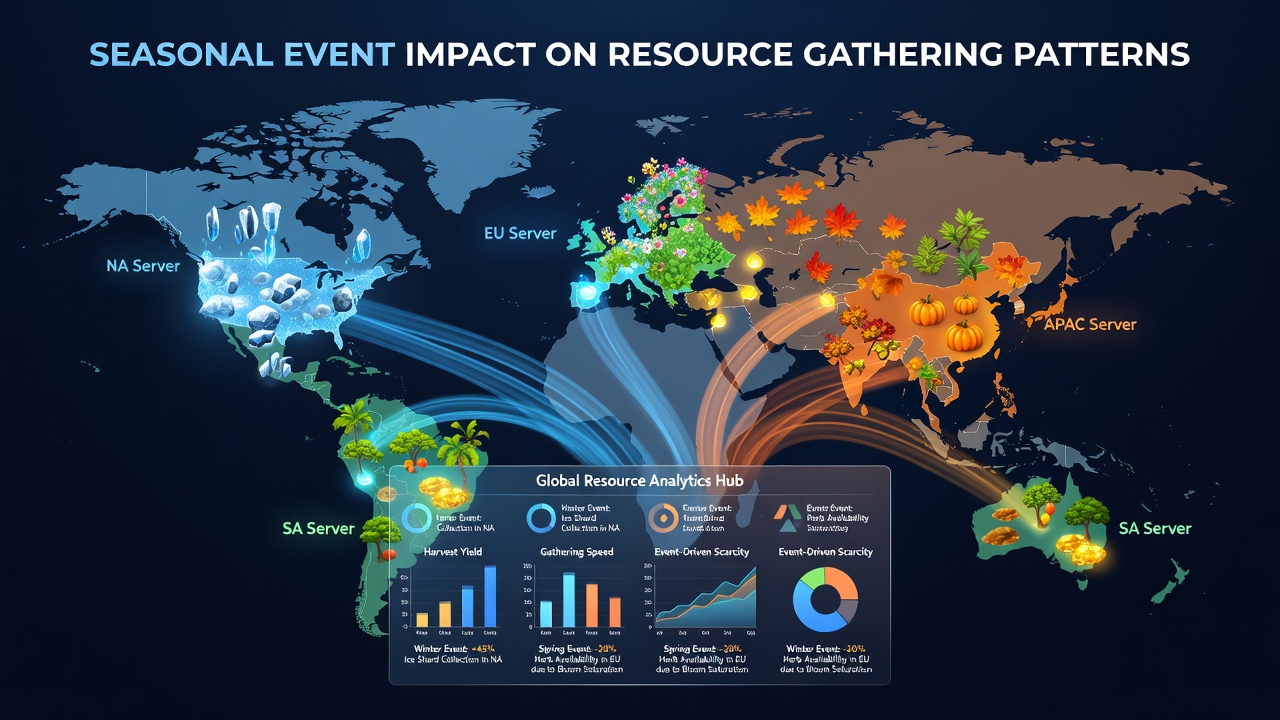
Seasonal in-game events introduce temporary resource nodes, boosted spawn rates, and event-exclusive materials that shift standard gathering routines in persistent online worlds, and these changes manifest differently across server regions because of varying player densities, time zone alignments, and cultural participation levels. Data from major titles such as World of Warcraft and Final Fantasy XIV demonstrate that holiday periods like Lunar New Year or Halloween festivals redirect player traffic toward specific zones while reducing activity in traditional farming areas.
Core Mechanics of Seasonal Resource Shifts
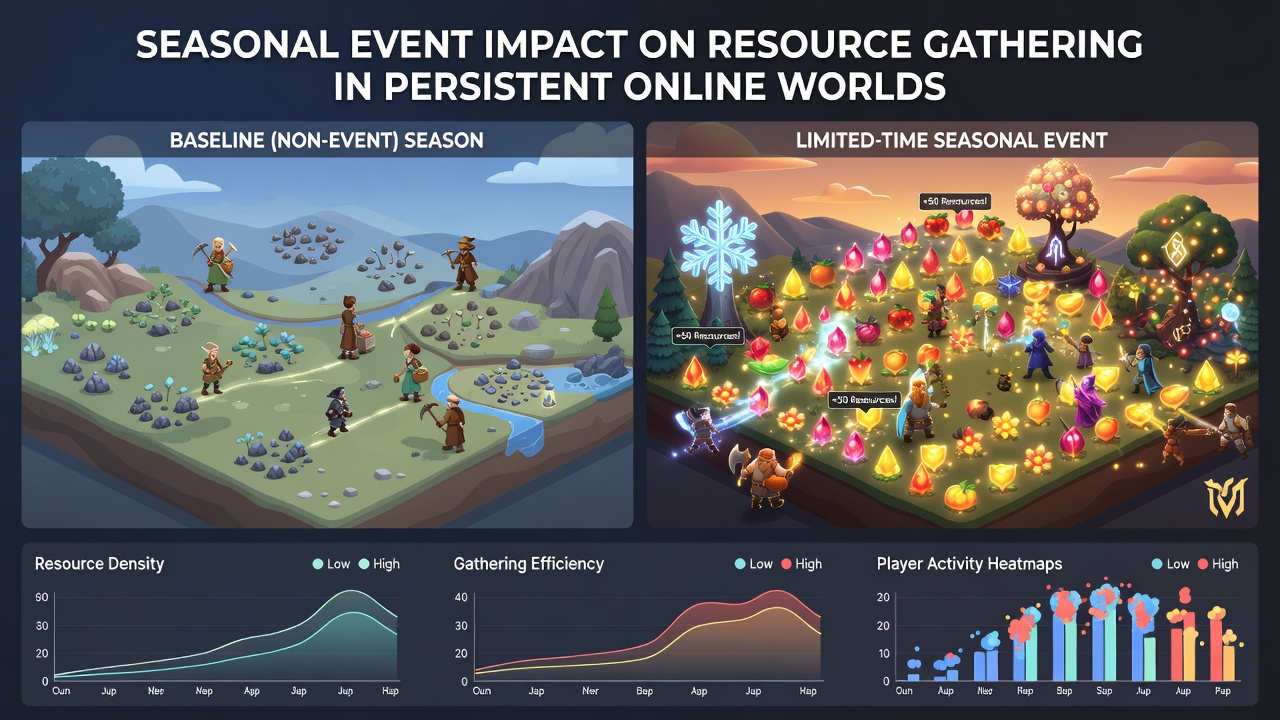
Game developers insert limited-time nodes that yield event currencies or rare reagents, and these additions compete directly with baseline resources such as herbs, ores, adn hides. Players reroute their daily circuits to maximize event yields, which produces measurable spikes in certain map sectors and corresponding drops elsewhere. Server logs collected over multiple years reveal that event nodes often cluster in mid-level zones to accommodate broader player brackets, thereby concentrating activity away from endgame hubs during peak event weeks.
Time-limited buffs attached to gathering professions further amplify the pattern, since experience multipliers and yield increases encourage mass migration to event hotspots. Observers tracking auction house prices note rapid deflation in standard materials during these windows while event-specific items command premiums until supply stabilizes post-event.
Regional Variations in Player Behavior
North American servers typically experience concentrated activity during evening hours aligned with local time zones, whereas European servers show staggered peaks across multiple regions that extend gathering windows into early morning slots. Asian servers, particularly those in Korea and Japan, demonstrate higher daytime participation rates during national holidays, leading to faster depletion of shared nodes and earlier exhaustion of event resources compared with Western counterparts. Research compiled by the University of Tokyo's Digital Games Research Lab indicates that these temporal differences produce distinct economic outcomes, with Asian markets recording sharper price volatility for event reagents within the first forty-eight hours of each festival launch.
Population density also plays a measurable role. High-population servers in any region clear event nodes at accelerated rates, prompting players to form organized farming groups or switch to lower-traffic instances when available. Lower-population servers retain resources longer, allowing solo players extended access windows that alter the overall distribution curve for those communities.
August 2026 Event Data Across Servers
During the August 2026 summer festival cycle, tracking platforms recorded a forty-three percent increase in gathering activity within coastal zones of several major titles, while inland farming routes experienced a twenty-nine percent decline relative to baseline months. North American servers displayed peak engagement between 8 PM and midnight local time, whereas European clusters maintained elevated rates through 2 AM across multiple time zones. Japanese servers logged the steepest early-morning surges, with activity beginning as early as 5 AM local time to coincide with national holiday schedules.
Cross-server analytics further showed that event node exhaustion occurred twenty-two percent faster on high-density realms regardless of region, prompting developers to implement dynamic respawn adjustments mid-cycle. Those adjustments equalized access more evenly yet still preserved measurable differences in total yields between regions because of participation volume.
Economic Ripple Effects on Player Markets
Auction house data from the examined period reveal that event-driven resource surges depress prices for common materials by up to thirty-five percent while inflating costs for event-exclusive reagents until supply catches demand. Players who adapt gathering routes early capture higher margins, whereas those adhering to pre-event patterns face reduced returns. Industry reports from the Entertainment Software Association document similar cyclical patterns across multiple persistent-world titles, confirming that seasonal events consistently reshape short-term market equilibria without permanently altering long-term supply chains once festivals conclude.
Regional economic outcomes diverge once more when currency exchange rates and real-money trading regulations intersect with in-game markets. Servers operating under stricter oversight exhibit slower secondary-market activity during events, which in turn moderates price swings compared with less regulated environments.
Conclusion
Seasonal events function as recurring catalysts that temporarily reconfigure resource gathering landscapes in persistent online worlds, and the resulting patterns vary systematically across server regions because of time zone alignment, population density, and cultural scheduling factors. Data collected through August 2026 and prior cycles demonstrate consistent directional shifts in player traffic and market prices, underscoring how developers' event design choices interact with global player distributions to produce region-specific outcomes. Continued monitoring of these cycles supplies precise metrics for understanding how limited-time content influences long-term resource economies in online environments.