Decoding Save State Manipulation Patterns to Bypass Progression Blocks in Emulated Platformer Ports
Written by Mia Hughes · Jul 19, 2026
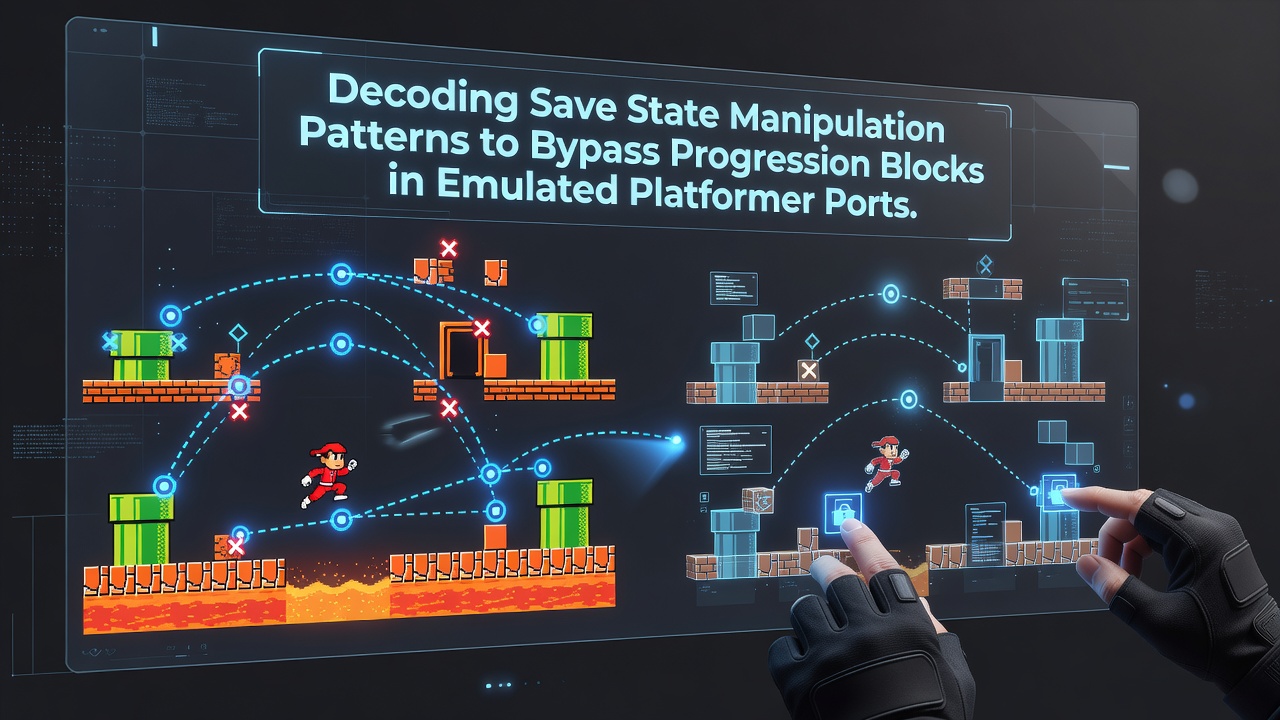
Decoding Save State Manipulation Patterns to Bypass Progression Blocks in Emulated Platformer Ports
Save states function as complete snapshots of an emulator's memory, CPU registers, and hardware state at any given moment during gameplay, and researchers studying emulation have documented how these files encode progression variables in platformer titles. Platformer ports on modern systems often retain original lock mechanisms such as key counts, flag checks, or checkpoint requirements that prevent forward movement until specific conditions are met, yet emulators allow direct inspection of the underlying data structures that represent those conditions.
Core Mechanics of Save State Files in Platformer Emulation
Emulators record the full RAM contents along with timing information from the original console hardware, which means variables controlling doors, collectibles, and level access appear as discrete byte sequences within the state file. Observers note that platformers from the 16-bit and 32-bit eras store progression flags in predictable memory regions because the original games relied on limited address spaces, and data from academic examinations of emulator accuracy confirms these patterns remain consistent across multiple hardware recreations. When a player reaches a blocked section, the corresponding flag bytes hold specific values that the game engine reads on each frame to determine whether passage is permitted.
Identified Patterns in Progression Block Bypasses
Analysis of save state files reveals recurring structures where progression blocks map to single-byte or multi-byte flags that toggle between zero and non-zero states, and those who've examined numerous titles report that platformers frequently cluster these flags near sprite and collision data. One common pattern involves a gate requiring three keys where the count resides at an offset that increments only after item collection events, while another pattern appears in checkpoint systems that store the last valid position alongside an enable bit. Researchers have mapped these offsets by comparing states captured before and after natural progression events, revealing that many blocks follow linear addressing schemes because the original cartridges allocated fixed memory banks for level data.
Additional patterns emerge when examining timer-based locks or enemy defeat counters, since these elements often share adjacent memory locations with movement variables, and studies of emulator behavior show that altering one byte can satisfy multiple dependent checks simultaneously. In July 2026, documentation from preservation projects highlighted how updated emulator cores improved visibility into these memory maps, allowing clearer observation of how platformer ports handle carry-over flags between stages.
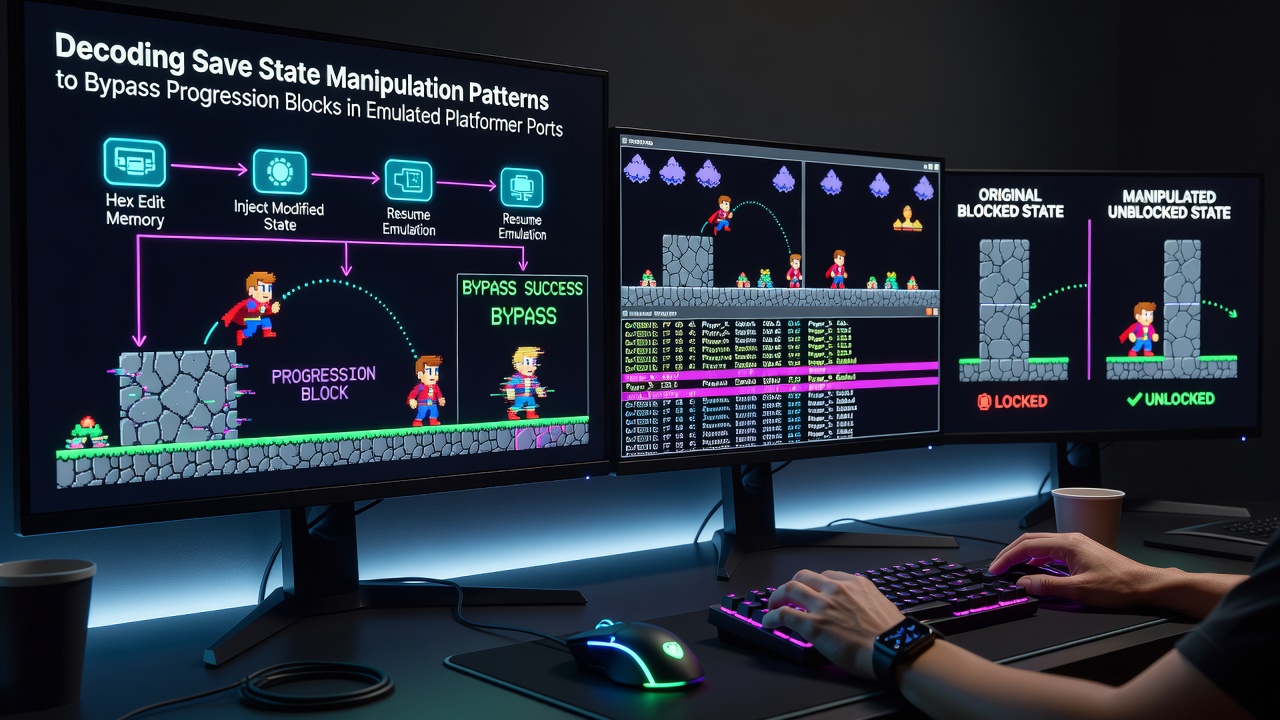
Tools and Techniques for State Examination
Specialized utilities parse save state containers to display raw memory in hexadecimal or structured views, and industry reports on digital game preservation indicate these tools originated from efforts to verify emulator fidelity rather than from gameplay modification. Users load successive states into comparison viewers that highlight changed bytes between captures, then isolate the addresses tied to progression by testing minimal alterations while the emulator runs. This process relies on the deterministic nature of console hardware emulation, where the same inputs produce identical memory states absent external variables such as random number generators.
Cross-referencing with disassembly of the original game code provides context for each flag's purpose, although many analysts work solely from memory differences because the pattern of byte changes follows repeatable sequences across similar titles. Data from university-led examinations of retro computing shows that 8-bit and 16-bit platformers exhibit higher predictability in flag placement compared with later 3D entries, owing to simpler memory management routines in the source hardware.