Analyzing Collision Detection Algorithms and Their Influence on Puzzle Solving Efficiency in Physics-Based Platformers Across Hardware Variants
Written by Morgan Simon · Aug 18, 2026
Analyzing Collision Detection Algorithms and Their Influence on Puzzle Solving Efficiency in Physics-Based Platformers Across Hardware Variants
Core Mechanics of Collision Detection in Platformers
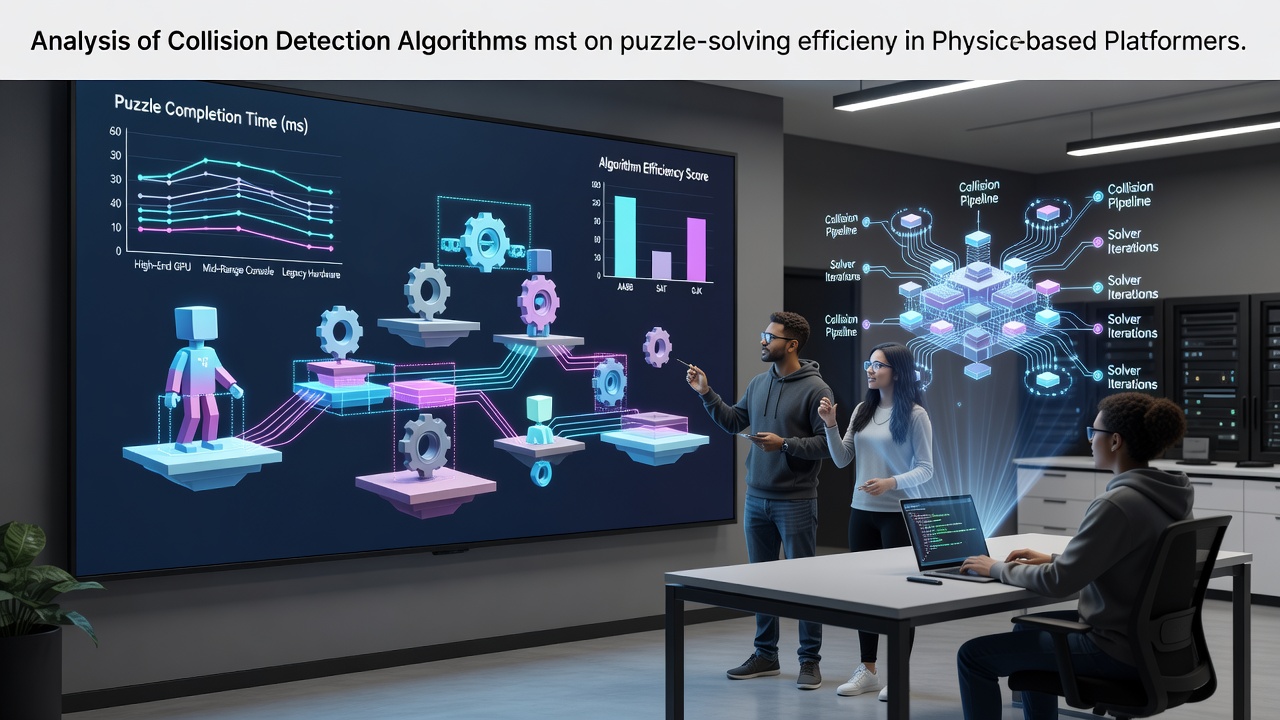
Collision detection forms the backbone of physics-based platformers where players navigate environments filled with moving platforms, switches, and obstacles that respond to precise physical interactions, and algorithms determine how objects register contact without unnecessary overlaps or gaps that could alter puzzle outcomes. Researchers have documented several primary methods including axis-aligned bounding boxes for quick rectangular checks, separating axis theorem for rotated shapes, and Gilbert-Johnson-Keerthi distance algorithms for more complex convex hulls, each trading computational cost against accuracy in real-time simulations.
Developers implement these techniques to maintain consistent frame rates while handling multiple simultaneous contacts, and data from performance benchmarks indicate that simpler bounding box approaches reduce processing overhead on lower-powered hardware whereas advanced methods support finer puzzle mechanics like angled surface slides or deformable objects.
Performance Variations Across Hardware Configurations
Hardware differences influence how collision algorithms execute because console systems with fixed architectures often optimize for specific instruction sets while personal computers and mobile devices encounter variable processor loads from background processes. Studies conducted at technical institutions in Canada and published through academic channels reveal that axis-aligned methods maintain stable timing on integrated graphics units common in portable hardware, yet they introduce minor precision losses that affect puzzle solutions requiring exact ledge alignments or momentum transfers.
Meanwhile, more sophisticated continuous collision detection variants appear in titles running on high-end desktop setups where dedicated graphics processors handle the extra calculations, and industry reports from European gaming associations note reduced input latency in these environments during sequences that demand rapid iterative testing of physics states.
Effects on Puzzle Solving Efficiency
Puzzle design in these games relies on predictable collision responses so players can experiment with force applications, timing, and object stacking, but algorithm choice directly shapes the feedback loop because discrete checks may miss fast-moving elements and force designers to widen tolerance zones. Observers note that games employing hybrid systems switch between broad-phase spatial partitioning for initial candidate filtering and narrow-phase detailed tests, which preserves efficiency without sacrificing the exactness needed for chain-reaction puzzles.

One documented case involves a platformer series where early builds used basic bounding volumes and players encountered inconsistent stacking results on certain consoles, prompting later updates that incorporated swept volume tests; subsequent player data showed faster solution times once hardware-specific tuning aligned detection thresholds. Research indicates that across variants, mobile implementations prioritize battery-conscious approximations while console and PC versions leverage higher precision modes, leading to measurable differences in how quickly users identify viable paths through multi-stage physics challenges.
Hardware-Specific Implementation Patterns
Engine middleware provides standardized collision modules that studios adapt per target platform, and figures from hardware vendor documentation demonstrate that vectorized instructions available on newer processors accelerate separating axis calculations by parallelizing edge projections. In August 2026, ongoing firmware refinements for certain handheld devices further narrowed performance gaps by improving floating-point throughput, allowing developers to deploy slightly heavier algorithms without frame drops during intensive puzzle sections.
Those examining cross-platform releases find that collision response consistency improves when teams calibrate restitution values and friction coefficients separately for each hardware tier, preventing scenarios where a solution that works on one device fails due to accumulated floating-point drift on another. Academic sources from Australian research groups have tracked these adjustments in several commercial titles and reported corresponding gains in puzzle completion metrics after such calibrations.
Broader Implications for Game Development
Teams balance algorithmic complexity against target audience hardware diversity because overly demanding detection routines can exclude players on older systems while simplified versions may reduce the depth of physics-driven puzzles. External analyses from international trade organizations highlight how middleware updates incorporate adaptive broad-phase structures that scale with available memory bandwidth, supporting larger object counts in open levels without proportional increases in solve time for players.
Engineers continue refining broad-to-narrow phase transitions to minimize false positives that waste cycles on irrelevant object pairs, and evidence from multiple platform ports shows these refinements contribute to smoother iteration during puzzle design phases where rapid prototyping of interaction sequences proves essential.
Conclusion
Collision detection algorithms shape the reliability and responsiveness of physics interactions that underpin puzzle progression in platformers, with hardware variants dictating feasible levels of sophistication and influencing solution efficiency through variations in precision and latency. Continued optimization across architectures supports more consistent experiences as development practices evolve to address platform differences systematically.